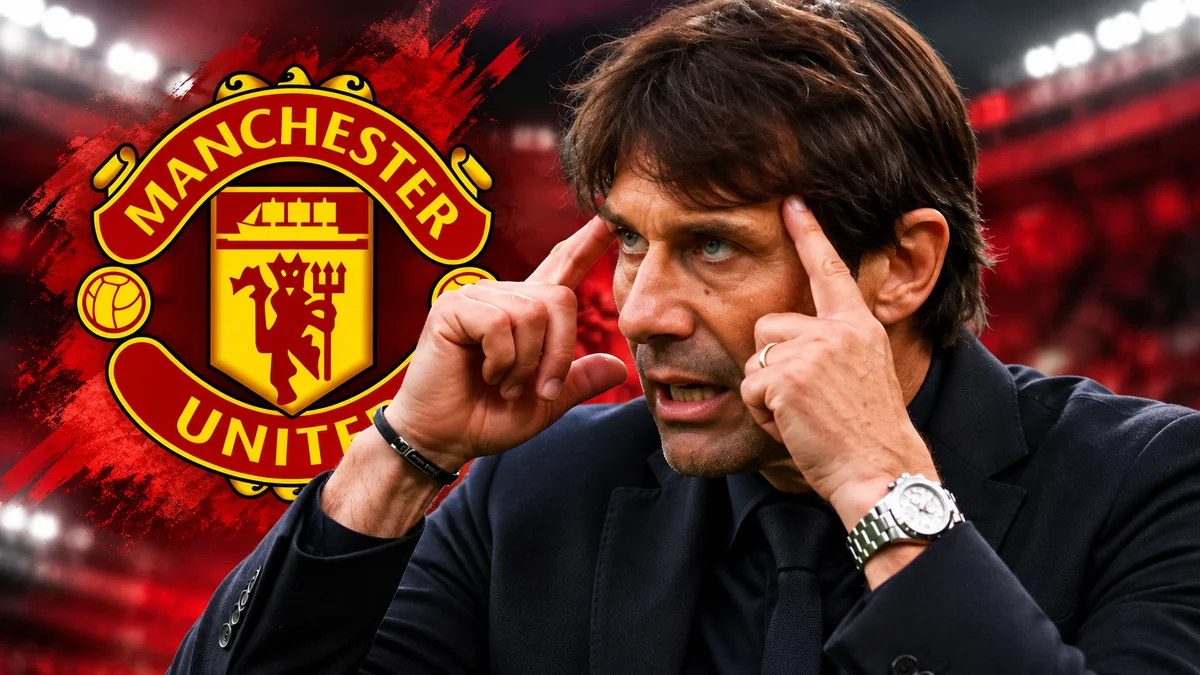
Michael Carrick is not the reason Manchester United keep stalling – but it is getting harder to see him as the man who ends the stall. If the club reaches for the reset button once more, there is a case for choosing the most uncomfortable option available: Antonio Conte.
Key takeaways
- Carrick's bounce is fading – his strong 17-game interim spell last season has not turned into lasting progress.
- Conte sounded out? Italian reports claim the 57-year-old has been approached, while English sources say the board still backs Carrick.
- A proven fixer – Conte has six league titles, four of them with four different clubs since United last won the Premier League.
- The catch – his demands would likely put him at odds with United's players and hierarchy almost immediately.
A job no single coach can fix
No manager, however gifted, can repair everything wrong at Old Trafford. The head coach has no say over an unpopular ownership model or an executive layer that rarely seems to answer for its decisions. The realistic ceiling for whoever sits in the dugout is to squeeze more out of a talented but uneven squad than its parts suggest.
Carrick did exactly that at first. Taking charge in the second half of last season, he sparked a rapid turnaround over 17 matches, largely by spotting a tactical fix his predecessor had missed and by lifting the mood around the dressing room. It is a familiar pattern at United: the caretaker who restores the good feeling.
The problem is that good feeling alone rarely survives a full campaign. Sustained success needs tactical clarity, mental toughness and physical edge – ideally all three – and Carrick's side currently looks short on each.
More than a decade of resets
Carrick's situation is not new; it is the latest chapter of a story United have been retelling since Sir Alex Ferguson retired in 2013. The club has not won the Premier League since his final season, and every appointment since has been a reaction to the one before it.
The post-Ferguson cycle
- David Moyes – the chosen successor, gone within a season.
- Louis van Gaal – the tactician, an FA Cup and then the exit door.
- José Mourinho – the serial winner, three trophies before relations broke down.
- Ole Gunnar Solskjær – the club legend who restored the mood.
- Erik ten Hag – the project coach, two domestic cups and a painful end.
- Ruben Amorim – the system builder whose back three never took hold.
- Michael Carrick – the former captain, calm, popular and now under growing pressure.
The pattern is striking: a bold appointment, a period of friction, a sacking, then a familiar face to steady the ship. Each swing of the pendulum has cost time, money and credibility, and each has left the next manager inheriting a squad built for someone else's ideas.
Set up to fail
To be fair to the former club captain, he has not been handed the tools. Once his early results boxed United into giving him the job permanently, the club owed him a squad capable of pushing on. Instead, the recruitment team appears able to tackle only one area per window: the attack last year, the midfield this summer. The defence – largely the same unit Erik ten Hag worked with four years ago – looks set to wait until 2027 at the earliest.
Carrick, diplomatic as ever, will not say any of this out loud. He is trying to keep everyone onside, and in doing so is satisfying very few. There is a certain logic to that from the hierarchy's point of view: a manager who absorbs criticism quietly is convenient. But convenience is not the same as progress, and United supporters have run out of patience with excuses dressed up as stability.
The usual shortlist
If change does come, the list of likely successors is hardly thrilling. Eddie Howe is the name that suggests itself first – not because he is the ideal fit, but because his steady, uncontroversial profile seems tailor-made for the current regime's comfort zone.
History says United tend to follow a feel-good caretaker with a tactician. But breaking the cycle may require something different: a manager willing to make players and executives alike uncomfortable. José Mourinho tried that in 2016, and was right about plenty – he won the League Cup and the Europa League in his first season and finished second the following year. But the club, still convinced that Ferguson-era success would simply continue on its own, was not ready to hear his warnings about the squad and the recruitment.
United arguably need a genuinely difficult character – someone with the authority, the CV and the intensity to push the boardroom above him and drag the squad along behind him.
Why Conte fits the brief
Conte's defining trait is simple: he wins. He has lifted six league titles as a manager, and since United's last Premier League crown he has won the championship with Juventus, Chelsea, Inter and Napoli. Again and again he has taken over drifting, underachieving sides and turned them into champions.
| Club | What he inherited | What he delivered |
|---|---|---|
| Juventus | Back-to-back 7th-place finishes | Three straight Serie A titles |
| Chelsea | 10th place in 2015/16 | 93-point champions, then the FA Cup |
| Inter | Nearly a decade without a Scudetto | Serie A title in his second season |
| Napoli | A 10th-place finish the year before | Serie A title at the first attempt |
For a club that prizes Premier League know-how, his Chelsea spell is the headline: he inherited a team that finished 10th in 2015/16 and turned it into 93-point champions within a single season, switching to a back three mid-campaign and going on a run of 13 straight league wins.
What Conte would bring
- Aggression – his teams press and attack with intent, an end to the passivity that has crept into United's play.
- Clear principles – non-negotiable standards rather than a rigid philosophy, something a successor could build on.
- Pragmatism – despite his well-known fondness for a back three, he adapts shape and style to the players he has.
- Standards – fitness, discipline and preparation that would lift the baseline of the whole squad.
The irony of a three-at-the-back specialist arriving so soon after the Ruben Amorim era would not be lost on anyone. But Conte is a pragmatist, not an ideologue – the system serves the results, not the other way round.
The Tottenham warning
Any case for Conte has to acknowledge how his last Premier League job ended. At Tottenham, he dragged a mid-table side into the top four in his first season, but the relationship soured quickly. By March 2023 he had publicly accused his players of being selfish and questioned the club's culture, and he left within days.
Critics see that episode as proof that Conte burns out wherever he goes. Supporters of the idea see something else: a manager who told the truth about a club that did not want to hear it – and a club that, years later, is still struggling with the very problems he described. For United, the question is whether they want someone who will expose their failings or someone who will quietly work around them.
The collision that might be necessary
Moving from Carrick's calm to Conte's ferocity would be a jolt for almost everyone at the club. Some players would bristle at the step up in training intensity, and a board that dislikes having its decisions challenged would soon find itself under scrutiny. Conte would demand signings, a say in recruitment and a defence rebuilt now rather than in 2027.
Yet that friction is arguably the whole point. United's stagnation has been fed by comfort and self-protection from the top down, and Conte is better equipped than most to break it. The bigger question is whether those in charge would ever be brave enough to give him the chance – and on recent evidence, that looks unlikely.
The bottom line
Carrick deserves more time, and the board reportedly still trusts him. But if United do change course, a safe, familiar appointment would only restart the same loop. Conte would be a risk – and perhaps the only kind of risk that could actually shake Old Trafford out of its rut.