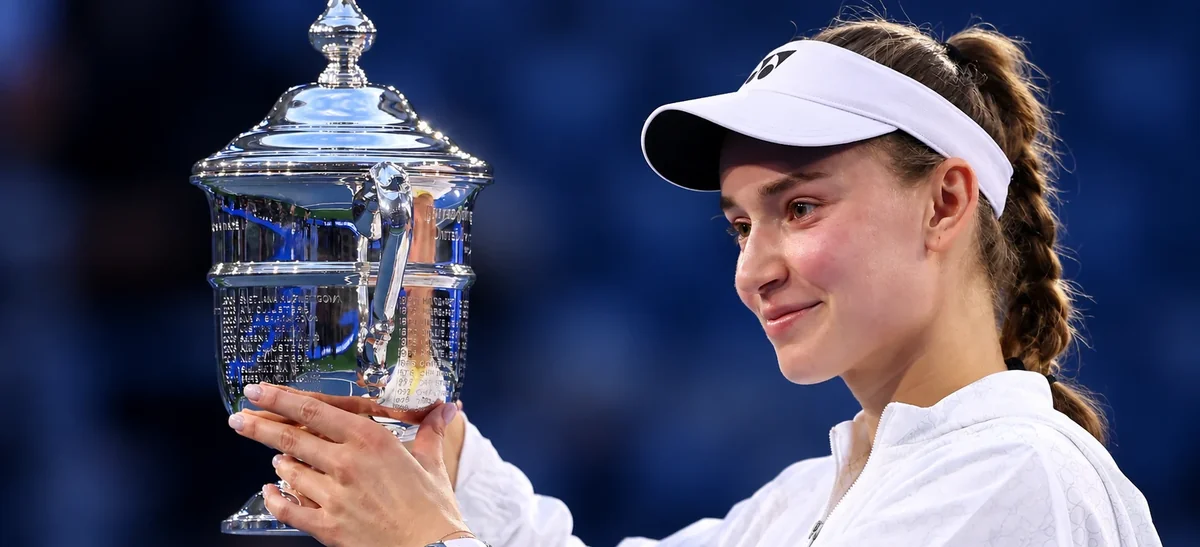
For a full set inside Arthur Ashe Stadium, Elena Rybakina looked like a player who had been beaten before she walked on. Her groundstrokes sprayed wide, the serve that has carried her career simply did not show up, and a packed Arthur Ashe crowd was loudly invested in the other outcome. An hour and a half later she was through to her first US Open final anyway — 3-6, 6-4, 6-4 — and the tournament had produced the title match it has been building towards since January.
The semi-final in numbers
- Result: Elena Rybakina (2) beat Coco Gauff (4) 3-6, 6-4, 6-4.
- What it earns her: a first US Open final and a fourth grand slam final of her career.
- The decisive shot: Gauff's forehand, which leaked 15 unforced errors.
- Head to head: only their third career meeting — Rybakina also came from a set down to beat Gauff at the Canadian Open last month.
- The final: Rybakina v Aryna Sabalenka, two-time defending champion, who dismantled Jessica Pegula in the other semi.
- The historical note: all four top seeds reached the women's semi-finals here for the first time in 51 years, and at any major since Wimbledon 2009.
The first set belonged entirely to Gauff
Gauff arrived with a question hanging over her. Her serve — the shot that reduced her to tears on this same court a year ago, and which she has since rebuilt into a genuine weapon — had wobbled badly in the previous round, where she needed to save two match points against Mirra Andreeva while serving twelve double faults.
None of that surfaced in the opening set. She served superbly at the moments that mattered, covered the acrylic end to end, and simply invited Rybakina to make the mistakes. Rybakina obliged. The set went 6-3 and it did not feel close.
Widening the court, one backhand at a time
Rybakina's response was tactical rather than emotional. Against a defender as quick as Gauff, hitting harder down the middle is a losing proposition; the answer is to make the court bigger. She started aiming for the sidelines, unspooling a run of sharply angled backhands that dragged Gauff off the geometry she had been controlling, and led 4-1 before the set had properly settled.
It was not pretty tennis from either player, and the set turned on the thing that had been quietly deteriorating all evening. Serving at 4-5, Gauff produced her worst game of the match: loose forehands and a double fault. One set each, and the momentum had changed hands without Rybakina ever finding her best level.
The forehand problem. Gauff's serve has been the story of her year, and it held up. It was the forehand, with its distinctive hitch, that broke down under sustained pressure from one of the heaviest ball-strikers in the sport. Fifteen unforced errors from one wing is survivable against most opponents. It is not survivable against someone who only needs one loose ball per game.
Then the serve arrived
Related reading
- Rybakina Ends Sabalenka's New York Reign and Completes the Hard-Court Double
- A New Name at the Top: Rybakina Takes No 1 as Shelton Breaks Into the Top Four
- Tears in Montreal: Jack Draper's Comeback Lasted Two Sets

The weapon that built Rybakina's career finally turned up in the deciding set, announcing itself with two thunderous aces to close out a hold for 2-1. From there her service games became formalities, and the burden shifted entirely onto Gauff, who was suddenly obliged to hold from a position of no margin whatsoever.
She nearly managed it. Facing two break points at 2-3, Gauff found a pair of big first serves to survive for 3-3. But she was broken at 3-4, and Rybakina walked to the baseline to serve for the match.
What followed was the passage that explains why this tournament has meant so much to her. Gauff, trailing 3-5, 30-30, lasered a backhand pass that had no business landing, and broke straight back for 4-5. A year or two ago that is the moment Rybakina loses the match. Instead she shrugged it off, stepped inside the baseline and produced an immediate return game to take the whole thing 6-4.
Six matches, none of them her best
The striking thing about Rybakina's fortnight in New York is that she has not played well at any stage of it. She came in with an Achilles scare in the build-up and a historically dismal record at this tournament — the one major that had never fitted her game. What she has done instead of playing well is manage every uncomfortable situation she has been handed.
She also arrived with a specific prize available: the world No 1 ranking, which she secured with a tense quarter-final win over Zheng Qinwen. Her reaction to that was to point out that the job was not half done. She had not come to New York to move up a ranking list.
Rybakina won Wimbledon in 2022, then waited four years for a second major. Her three grand slam finals since that first title have all come on hard courts — and she now has a chance to finish 2026 with two of them.
— The shape of a career that took its time
No 1 against No 1
The final is the rivalry that has defined the season, restaged with the rankings inverted. Aryna Sabalenka is the two-time defending champion here, and the departing world No 1 — beaten to the top spot by the woman across the net. Rybakina beat her in the Australian Open final in January. Sabalenka arrives having taken Jessica Pegula apart in the other semi.
It is also, in a broader sense, the match this draw deserved. All four top seeds reaching the last four is a statistical rarity — it had not happened in the women's singles here for 51 years, nor at any major since Wimbledon in 2009 — but nobody in New York found it remotely surprising. The top of the women's game has rarely been this settled or this hard to break into.
The bottom line. Rybakina has spent this fortnight winning matches she would previously have lost, with a serve that took six rounds to show up and a tournament record that gave her no reason for confidence. That is a more dangerous version of a player than one in full flow — because the level she has not yet reached is still available to her. Sabalenka has won the last two titles on this court. She will not be facing the Rybakina of the first set on Saturday.
Rybakina and Gauff had met only twice before this semi-final; Rybakina now leads their head-to-head 2-1, both of her wins coming from a set down.